What is Jeju Olle Trail?
437 km of well way-marked walking trail around South Korea’s largest island, Jeju. There are a total of 27 routes, 21 of which are considered part of the connected and looped main island trail. The other 6 dash routes (example 1-1) are mostly located on smaller nearby islands with some exceptions.
The routes do not go from start to end in a straight line. That’s because the philosophy behind the whole trail is to take a break from every day living, slow down, and just take some time to relax. Life is certainly hectic here in South Korea. Working hours are incredibly long and the work environment can honestly brutal. Therefore for Korean walkers it is a chance to leave all of that behind for a while…
Jeju Olle Trail is not a trail designed to be a completed loop of the island in the shortest and fastest amount of time.
“It all started in September 2006, when Suh Myung-sook, the editor-in-chief of South Korean current affairs website OhmyNews, decided to pack up her newswoman notebook after 23 years and fly to Spain for a pilgrimage trek at El Camino de Santiago. Believed to be the path of Saint James (Santiago), it has attracted countless pilgrims in search of spiritual healing and rejuvenation.
As has been chronicled, while walking the trail, Suh met a British girl called Hennie, who then gave her some food for thought, “If the journey was so great for us, why not build our own El Camino de Santiago in our homeland when we go back?”
This jolted her memory of Jeju with its beautiful and serene Olle, or narrow walking paths, around the island. She resolved to recreate the Santiago route in South Korea. Upon returning home, she embarked on the restoration of the old Olle and the creation of new ones. The first Olle trail was opened in 2007…”
Olle for a Slower Life | The Star Online
Where exactly is Jeju Olle Trail?

Jeju Island is the largest island in South Korea. The island is about 73 km from western to eastern tips. It is about 30 km from northern to southern points. It is one of the most southerly islands in the country with the tiny places of Gapado (Route 10-1), Marado (no Olle route), and Iedo (semi-submerged rock with research station) being the only pieces of land further south.
Do you have a completion certificate system?
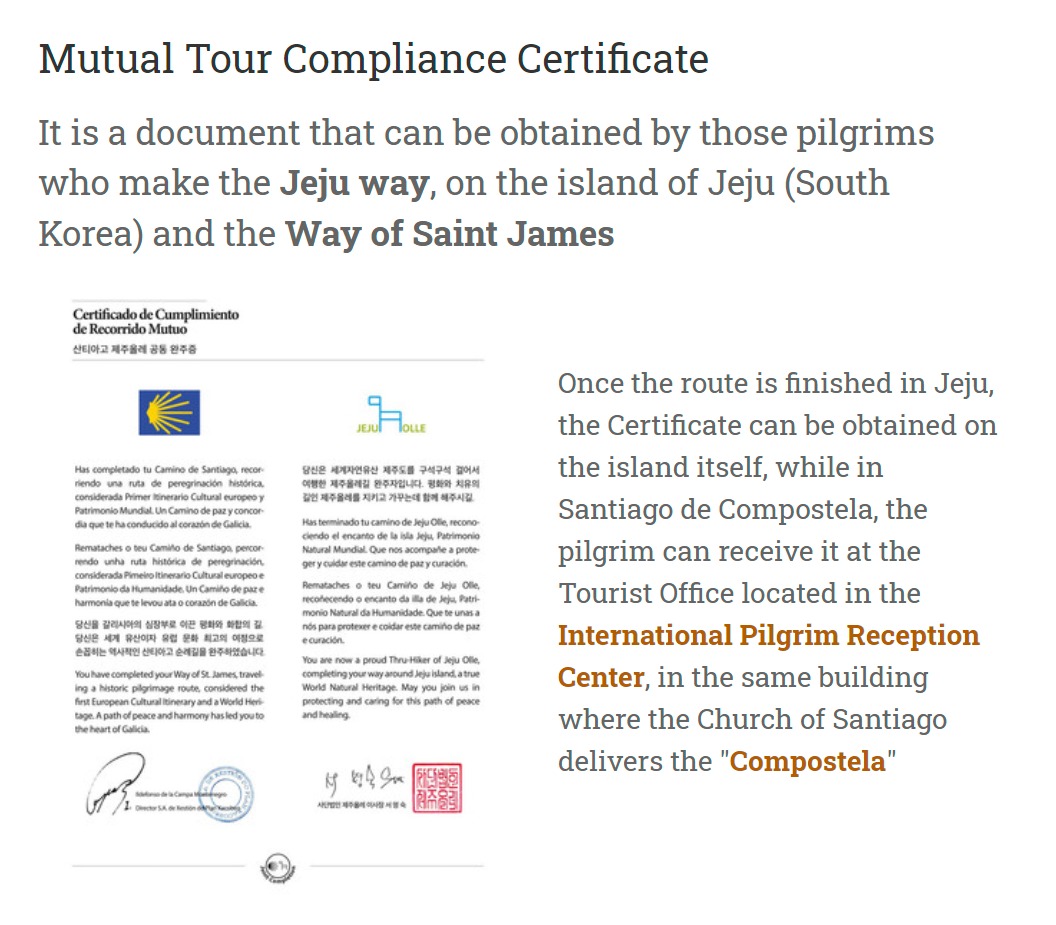
A walker will need all stamps from all routes in their paper Olle passport (20,000 KRW) or smartphone app Olle passport (free download, Korean-language only, Korean phone number needed to access some services, in-app passport purchase option 20,000 KRW) for the 437 km completion certificate and mini-medal (extra 5,000 KRW). More recently a 100 km completion certificate has become available too. We also have a joint completion certificate system with the Camino in Spain.
Can I download apps for planning and helping?
Unfortunately (due to the neighbour in the North) Google Maps is not particularly useful here in South Korea. The satellite view is low quality and out-of-date. Do not despair. There are two free Korean-made apps that have English-language options. They are rather good for Jeju Olle Trail.

One is made by Naver (iOS Version | Android Version) and another by Kakao (iOS Version | Android Version). Walkers should certainly download and familiarize themselves with at least one of these apps before arriving in the country or on the island. For example, the Kakao app has a dotted blue line (sometimes orange denoting wheel-chair accessible section) for the whole trail. Walkers can also check exactly where their bus is in the map. We had a suggestion from a walker about using Naver for finding accommodation along the trail. You can search guesthouse, minbak, or pension in English near your location and it will translate that into Korean and suggest places to stay.
When should I walk Jeju Olle Trail?
A difficult question to answer indeed. This is because everyone in the world has different climate tolerances and walking habits. Some people like to be up and out there in the wide world before the day gets too hot. Others are late risers and prefer finishing the trail later in the day. So. generally, late March to mid-May is the most comfortable walking period earlier in the year. Later on mid-September until mid-November is considered the best time to be on the trail. Especially the month of October. Walkers do enjoy the cold and windy winter walks. We strongly (and I mean strongly) discourage anyone from walking the trail from late June, July and August. The summer heat it is a very unpleasant experience. Even if you are from a tropical country near the equator. Do something else with your time here. Really. Really. Like going to the beach or climbing Halla Mountain.
How long will it take me to walk Jeju Olle Trail?
Well, walkers doing one route a day should take 26 days in total. But Route 18-1 and Route 18-2 on Chuja usually requires an overnight stay in a guesthouse so that’ll stretch the trip to 27. Walkers need 21 days if they are only walking the main routes on the main island (no break days). Some walkers have done two routes in a day and covered up to 40km. But the philosophy behind Jeju Olle Trail is to go slow and enjoy the break from every day life. Therefore is it impossible to give a firm and fixed amount of time.
I would like to find someone to walk with on Jeju Olle Trail. Is it possible?
After meeting and chatting with two ladies on the trail in late April 2026, we all realized there was no central online method for walkers to find a walking companion. To solve this problem, a Facebook group was created so that anyone who wants to walk together, for companionship or other reasons, can connect and arrange meetups on Jeju Olle Trail. It is also a new group for up-to-date information. The group is private and will require answering some membership questions. Safe-guarding personal information from everyone on the Internet is important. Link: https://www.facebook.com/groups/2764665137226219
What level of fitness do I need to walk on this trail?
There are so many factors involved with trying to answer this question. Each route has its own difficulty level, so please check that point before departing. Also, check how many oreums (small parasitic extinct volcanoes) each route has. These hills all vary in size and steepness. Though in most cases de-tours exist to take you around them. What we can say say is that Jeju Olle Trail is not a wilderness trail with hikes above tree lines and extreme dangerous weather to deal with.
What about camping?
It is a kind of difficult to give a definitive answer. There are no routes that have a camp site at the start or end point. Then you’ll find the routes that do have a camp site, well, the sites are in the middle, which is just not practical because you have to walk back from the end of a route. Camping rules are generally not hard-and-fast. It really depends on who happens to be around at that time and where you are exactly when you decide to camp. So at the end of the day if you can find a quiet, secluded corner, in a farmers field or a rest pagoda you will generally be fine. And if anyone does show up flash them a friendly foreigner smile and say ‘Jeju Olle’. Hopefully that’ll be enough for you to spend the night wherever you are and move on in the morning.
After a recent email correspondence I would like to add that is much much common for walkers to stay inside rather than camp on Jeju Olle Trail.
Can I store my luggage somewhere on the island?
Send an email to jejuolletrailinformation@gmail.com. I have kept luggage for many walkers over the years. However, I am only a volunteer and sometimes my schedule is so busy. However, it doesn’t hurt to ask.
You should also send an email to our HQ via jejuolle@jejuolle.org. There are coin lockers on the ground floor and a larger luggage storage room. We deal with each request on a case-by-case basis because, well, everyone will be staying different amounts of time, have different amounts of luggage and different sizes of luggage.
I do not know of any English-language baggage transfer services on the island. There are Korean-language baggage service transfers but there will be a language barrier and communication issue. I will not be able to organize this for a walker.
What about the extra -1 routes. Should I do these too?
We have 21 main routes on Jeju Olle Trail. There are six small routes each with their own characteristics.
Route 1-1 on Udo Island is a mixed bag due to heavy tourist traffic. There are cars, buses and cyclists. Actually Jeju Olle Trail advises against walking this route during the summer (it will also be hot and there is a lack of shade). If you can hike on a weekday or start with an early ferry you’ll be okay.
Next up is Route 7-1. This is a walk from the World Cup Stadium in Seogwipo and actually takes you back in the Seogwipo. It is uphill at first with an oreum hike and then down hill for the ending part. Yes, this route is worth adding in.
Route 10-1 on the small island of Gapado. If you walk fast you can get this done in under 2 hours. The point of this route, however, is to go really slow and just take in the uniqueness of small island life. Plus you can stop off at the school and have your picnic or prepared lunch on the grass field.
The best extra route on the main island is Route 14-1. This includes the Gotjawal Forest for much of the day. The only taste of real civilization is the O’suloc Green Tea Fields at the end. You’ll be spat out into a tourist mecca.
And.
Chujado 18-1 and 18-2.
See below.
I see two routes on Chuja-do? The journey seems long and arduous ?
We have Route 18-1 and Route 18-2 on Chuja-do. These islands are about one hour from Jeju on a fast ferry. Walkers can do these both on the same day but we do suggest a one night stay to do the hardest Jeju Olle Trail routes properly. Chuja-do is a rugged, hardy, and beautiful place for any international visitor who manages to make it that far. You must check the weather forecast because ferry services are often cancelled. You might get stuck on the islands for an extra day(or two). The fast ferry can be extremely vomit inducing. Please think about taking some anti motion sickness medicine before getting on that fast ferry. Please. What about accommodation? What about the ferry schedules? They change so much just send me an email directly for the latest information.
Which route is the best?
Don’t ask this question! No. Stop! Right now! You see every walker has their favourite route on the trail. That favorite choice could change depending on the time of year as well. But if you insist and only have a day or a couple of days to walk then please consider these routes:
Route 1, 6, 7, 18
These are routes recommended to foreign walkers over the years.
Route 1 gives you a standard introduction to Olle and Jeju Island over on the east side of the island. Walkers get a countryside feeling at first followed by Seongsan Sunrise Peak towards the end. This route isn’t super long either. Plus the bus stops are really close to the start and end points. You’ll have three oreum climbs in this day (one optional at Sunrise Peak).
Route 6 takes walkers through Seogwipo and has a lot of cultural sites along the way including waterfalls. Starting at 9:30 a.m. you can be finished by lunch. Then spend the afternoon exploring Seogwipo City. There are no oreums on this route. I would consider this the best and easiest introduction.
Route 7 is considered Olle trail’s most popular route. Certainly the first part is very popular, however, I’m not a huge fan myself. I’d probably choose Route 6 over Route 7. I would do Route 7 on the following day. Though for the foreseeable future (2026) Route 7 has changed quite a bit. That’s due to some road construction. This construction means the route actually doesn’t connect to the end of Route 8. Plus there is a uphill from Beopwhan Port to the World Cup Stadium at the finish. If you are confuzelled by anything I’ve put above send me an email. I’ll do my best to explain the situation.
Route 18 is a personal favorite of mine. You’ll see a different side of Jeju Island that many tourists don’t see. The landscape on this northern route is different to that of the exotic feeling of Seogwipo. Route 18 starts in Jeju City, but slowly leaves it all behind. Move into Samyang for lunch and then along country roads and paths for the afternoon. That is quintessential Olle. Start points and end points have easy bus access. Though Route 18 is quite long. Keep that in mind.
Should I do the trail in order?
Picking and choosing routes will leave walkers with no overall sense of how the trail changes throughout the varied landscape of the island. These days international walkers seem to be starting more at Route 7. This is because the Olle HQ is located there and the only place to get the completion certificate. Start at Route 7. Finish at Route 7. Convenient.
Walking clock-wise or anti-clockwise?
Jeju Olle Trail can also be walked in either direction. Blue painted arrows denote a clock-wise direction. The orange arrows denote a counter-clockwise direction. However, I have never known of any walkers going counter-clockwise on their first walk. Everyone usually goes from Route 1 around to Route 21 in a clock-wise direction. Those who live on Jeju Island tend to walk in reverse after completing the whole loop for a fresh approach.
Should I reserve accommodation for every day on the trail?
First, I will not recommend accommodation to walkers. Every walker has their own tastes, budget, and expectations. But I will give you advice about the location and connecting to the trail. I know a lot of walkers also have this romantic notion of going until the day is done and not worrying too much about wherever they may end up. However, I strongly suggest making your accommodation reservation at least one day in advance of arrival. Internet sites are often cheaper than turning up on the doorstep. Please use sites like hotels.com or booking.com.
Are there any events for walkers?
Yes, we have two events in a month that might be of interest. Clean Olle is an officially sanctioned volunteer group choosing one route and tidying up the trash found along the way. Trash tongs, bags, and other support materials are provided. We also have two official festivals. The first one happens earlier in the year and is specifically for children. Then in early November we have our big bash. Did you see the video on the front page of this site. You’ll get the scoop on the Jeju Olle Walking Festival by watching that. Go do it.
Do I need to send resupply and food packages to myself on this trail?
No, you do not. Jeju Olle Trail does not have remote sections without food or water for days. This trail is not as challenging as the Appalachian or Pacific Crest Trail at all. Routes start, pass through, and finish near bus stops and villages throughout the day. There are modern convenience stores selling typical snack foods and beverages. You’ll never be more than a short walk or short ride from being able to resupply or eat. The challenge is more about overcoming the language barrier and finding somewhere to eat that is agreeable with your tastes (especially if this is your first time in Korea with Korean food). Though with the aid of your smart phone even the language barrier has been pretty much broken down these days.
Can I walk with my dog on the trail?
The trail is open to pets as well. However, walkers use typical dog owners common sense. Especially in sections where routes pass through fields with livestock (cows and horses).
Should I be worried about the animals?
You shouldn’t be worried about bears, mountain lions. But the island does have some critters to look out for. Those include pet dogs in yards and gardens along the way. Some of them will be on a leash. Others will not. They might follow you down the street. There is a small possibility you might meet a wild dog here and there. Then we have deer in some of the forest sections or even wild boar (extremely rare). When you’re going through areas with high grass you may have to protect yourself from tick bites. Some ticks on the island do carry a not-very-nice disease. Actually you’ll probably get startled once or twice by a pheasant making squawking noises in the bushes as you walk by.
What about walking with children?
This is a question that arrives in my inbox from time-to-time. It all depends how old they are, what type of parents you are, and past walking experiences. Please use common sense.
You don’t want to be walking Jeju Olle Trail in the high summer months (July and August) with young children in strollers/push-chairs. During that time you don’t even want to be carrying children on your back. The same goes for winter.
From personal experience I have found walking half an Olle route more than enough with children.
Route 15-B from Hallim to Gwakji Beach offers a good walk. Not too long and not too short. There are restaurants and cafes along the route, including the awesome dragon-on-the-building Chinese restaurant. Don’t worry, you can see it from the route. Plus Route 15-A finishes at Gwakji Beach where the kids can play in the sand.
If you have older children then the start of Route 18 until the middle point in Samyang is good, too. It’ll be a 3.5 hour walk with cafes and restaurants as you walk. At the end you’ll be at the black sand beach and an easy bus ride back to the start point.
If a walker is bringing a stroller/push-chair then check the official web site for sections marked with a blue/orange line. You can go there.
I have a question that is not answered in this amazingly comprehensive FAQ that took a long time to write.
Well, it’s a good job I am such a gracious person and have provided this email address. Just send any further questions and I will do my best to answer. No problem at all. Email: jejuolletrailinformation@gmail.com
You made it all the way to the end. Now it is time for your easter egg. Enjoy.
In 2025 we found the lady who gave our founder inspiration to start Jeju Olle Trail. Here is a story translated from the Korean news. The story was written by our founder.
[Seo Myung-sook’s Olle Trail Letter] 17. Finally, I found her. Bravo!
It was truly a long-standing ache and a task. Finding her, with whom I had lost contact for 19 years. Although we hadn’t met in person, we reconnected in late October, a few days before the Olle Festival. The moment I heard the news, I was so excited I jumped to the ceiling. Even with a severe flu that choked my voice, I let out a silent scream.
After finding her, another task arose: I had to share this news with the readers of my book, “Nolmeong, Shimeong, Geuleumeong,” and with the Ole fans who knew her. I’d been putting it off because of a cold, but before the year was out, I finally opened my laptop. Now, let’s begin the story.
Hennie and I, my companions on the road to Santiago, who were so cruel
Any astute Ole traveler would have guessed who the “she” I was looking for was. Yes, it was “Henny the British Woman,” who had urged me to return to my homeland and forge my own path.
Looking back, our meeting on the Camino de Santiago was almost fate. I met her the day after the most brutal and frightening night of my Camino de Santiago pilgrimage. I finally arrived at the village where the albergue was located just as sunset was approaching, but all the beds were already taken. I begged her to let me sleep anywhere, even in a barn, but she refused. The only kindness she offered was, “There’s another albergue just two kilometers further.”
I couldn’t even take a single step, and two kilometers? I felt like I was on the verge of tears, but I managed to keep going. As I entered what seemed like an uphill mountain path, darkness fell in an instant. Then, I sensed something running from afar. It wasn’t just one, but three or four large dogs. Fearful of provoking the dogs, I couldn’t move a single step, so I shouted in Korean.
“Someone catch those dogs!”
The sky wasn’t indifferent. Someone appeared on the summit and whistled, and the dogs rushed to him. It turned out he was the albergue manager, and the dogs were his family. Amidst a mixture of resentment and gratitude, I finally felt alive when I was assigned a bed. It was a mountain albergue, so I was practically alone. The village was called Casanova. An unforgettable name!
Meet at Casanova Cafe and eat some bulgogi in Melide
The next morning, I was hungry, having slept without dinner the night before. I went to a local cafe for breakfast. The cafe’s breakfast was bliss itself. After skipping a meal, the taste of the Spanish egg and potato omelet and the café con lache (Spanish milk coffee) were divine.
Perhaps it was because I looked so happy. The woman sitting at the table across from me greeted me. She was Hennie. Hennie was from England and said today was her 32nd day of walking. I was on my 33rd. Having started a day apart, we had matched paces at Casanova. We chatted briefly, and she left first. “Buen Camino!” Meetings and partings on the road are always cool.
But soon enough, I saw a woman lounging in the shade of a large tree by the roadside. It was Hennie. Seeing her, I felt embarrassed for walking like I was doing homework. I sat down beside her and stared blankly for a while. After some small talk, we both realized we shared a desire to eat bulpo in the next town, Melide. Hennie also had a tip for a good restaurant. I decided to follow her.
The Pulpo exceeded my expectations. The octopus, seasoned with olive oil and Spanish chili peppers in a traditional restaurant setting, was surprisingly tender. With the option of vino blanco (white wine) instead of water, we relaxed and began chatting about Santiago. Why he quit his job, what he traded for, and the good and bad moments…
We were both middle-aged women in our late 40s and early 50s, having left careers of over 20 years to choose this path. The realizations and changes we experienced along the way were strikingly similar. Despite our different nationalities and occupations, we also shared a common conclusion: “The road is a happy general hospital.” Just as walking builds muscle in your legs and sheds fat, so too does your mind, building muscle and shedding fat. This was the conclusion we both reached after over a month of intense training.
The conversation turned to “After Santiago.” Hennie said she’d build a road in her coastal village when she returned home. “Why should a road like this only exist in Spain? Every country, every village should have one,” she argued. I gasped inwardly. I’d thought it would be nice to have a road like this in Jeju, but I’d hoped someone else would do it, not myself. All I’d decided was that when I returned, I’d write an article about it for the Jeju press. “Oh, but there are people who decide to do this themselves,” I thought, as my mouth gaped open. Hennie made a strong suggestion.
“You too, make your way home. I’ll go to England, you to Korea. Let’s exchange paths later.”
Her passionate persuasion fueled my longing for the beaches and oreums of Seogwipo, Jeju, that I’d walked as a child, all the way along the Camino de Santiago. I longed for my hometown, Jeju, to be treated like a cheap, rip-off tourist destination during the international travel boom of the 2000s. On the Camino de Santiago, I discovered a powerful solution to revitalize Jeju and showcase its pure charm, and I pondered how to share and persuade Jeju society with this idea. Ultimately, I was ignited.
‘Yeah, I’ll go back home and make my own way. That English woman does that too.’
I nodded to her without realizing it. We exchanged contact information, promising to meet again. She said she’d pick me up at the London train station if I called, and even wrote down her home address, contact information, and email address. I, who tends to lose things, hid the piece of paper away, not knowing I’d never find it again.
After returning from Spain to Jeju, I found, connected, and opened a path with my brother and the other expedition members. And for 18 years, I lived and protected that path with volunteers. Throughout all that time, I never forgot Hennie. Even during difficult times and moments of overwhelming fulfillment, I would ask myself, “Why did you leave me?”
“Do you also find it this difficult, or do you feel this overwhelming sense of accomplishment and joy?”
But I couldn’t ask her directly. No matter how hard I searched, the piece of paper with my address never turned up. Every time I met a foreigner, I mentioned Hennie and asked them to help me find her. At the World Trail Conference, at the Asian Trail Conference, even with foreign Olle hikers I met along the way. But time passed without any word from Hennie.
The Miracle Discovered by the “Missing Hennie Project” and AI
I was reminded of my search for Hennie again when I met Christina, an American Olle hiker, ahead of the festival in late September 2024. Christina, a professional woman who worked as a nutritionist for the UN and traveled to many countries in need of food aid, said she had come to walk the Jeju Olle Trail at the recommendation of her Korean coworker, Sophia. I met her by chance at the Jeju Olle Traveler Center, and as we walked Course 7 together, I brought up Hennie again. Her reaction exceeded my expectations. Her eyes sparkled with interest, and as she left Jeju a month later, she voluntarily promised, starting today, that she would form a “Missing Hennie Project Team” to find her. She would also recruit Sophia, her UN colleague, and Margherita, an Italian woman she’d met on the Olle Trail. I was overjoyed.
After that, the Missing Hennie Project team worked hard to find Hennie, posting her story on European people-finding websites, trail-related bands, and social media. An unexpected helper arrived: Anne, a Korean-born American who had retired and volunteered for the Camino de Santiago. Anne advised me to post my story on a band and website popular with British pilgrims, and I became the fifth member of the project team.
But after about a month, nothing much happened. Christina tried to check old records at the Saint-Jean-Pied-de-Port Association of Santiago, the starting point of the French section of the Camino de Santiago, but was told there were no such records or that no personal information was available. Just as everyone was starting to feel discouraged, Sophia, who was known as the team’s detective, made a new suggestion. She suggested showing the AI a photo of Hennie, the only remaining clue, and asking it to find her. However, the resolution was low and the photo was over 20 years old, so my expectations weren’t high. “Even if it’s AI, can it really find her across so many years and across so much space?” I couldn’t imagine it.
But soon after, Sophia sent me two photos. They were of two people from a small magazine from Andalusia, Spain. One seemed to have a British name, the other a Spanish one. Sophia decided to contact me directly by email to confirm. To my surprise, the two women the AI had identified were the same person, with only different names. The reason for this was also revealed: she had long ago emigrated to Spain, not England, and was living in Andalusia. Her real name was Jeanne Catherine Henney. The Henney I remembered was not her first name, but her last name.
After our dramatic success in finding someone, Jeanne joined our group under Sophia’s guidance, and we had many conversations afterwards. Jeanne was particularly touched by the fact that I had actually created the trail after returning to Korea, and was astonished that I still remembered her and was looking for her. After reconnecting with me and scouring the internet for information about Jeju Olle overnight, she was even more impressed by my discovery of such a famous trail, and she fervently expressed her desire to come and walk it.
I asked, “Did you build a road? Did you struggle to maintain it like I did?” Jeanne answered. She hadn’t built a road herself, but she had walked another. As befitting a nation of trails, Britain already had so many, she gave up on building one. Instead, she joined a minority environmental party in Britain to protect the environment, actively working for it. Then, one day, she heard news that a large-scale development project was underway in a mountain village in Andalusia, where she had bought a small piece of land hoping to live in her later years. She immediately went to Spain, founded a local environmental party, and has been campaigning against overdevelopment. She said that, for her, that too was a “road.”
It’s time to conclude this long post. Look forward to it, everyone. She and her friend have decided to visit Jeju for a fortnight around the “2026 Spring, Jeju Olle” (Thank You Party), a special event to thank Jeju Olle volunteers for their hard work and award their contributions. She’ll attend the party, but she’ll also walk several Olle trails, as her friend, at her suggestion, has taken the initiative to create the trail. At 73, she won’t be able to finish the entire trail, but she’s already excited about taking it easy, enjoying Jeju’s ocean, oreums, clouds, villages, haenyeo (female divers), and Jeju cuisine to the fullest. If you see Henny, or rather Jeanne, along the way, give her a big smile and say thank you. Without her, the Jeju Olle Trail might not exist.
출처 : 제주의소리(https://www.jejusori.net)
 Jeju Olle Trail Official English Guide
Most of the walks lasst 3-4 hours or more. If my stamina is about an hour and I would like to turn back, can I do that or do I have to walk in one direction to finish the trail?
Good morning Sharon,
Yes, you can turn around and walk back. Just follow the orange arrows. Jeju Olle Trail can be walked in a clock-wise or anti-clockwise direction. Both ways are signposted. If you have some further questions please send them to jejuolletrailinformation@gmail.com. Thank you. Jim.